


What You Need to Know About Iranian Author Sadegh Hedayat
Sadegh Hedayat's Self-Written Biography

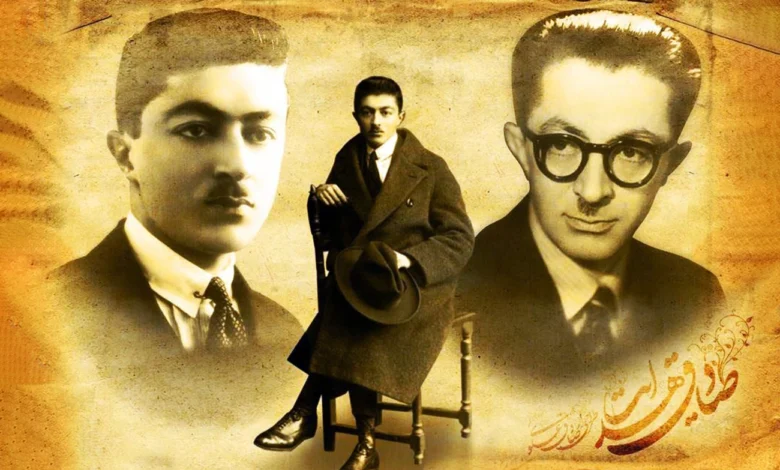
Who is Sadegh Hedayat?
Sadiq Hidayat (18 February 1281 – 19 April 1330) was a Persian writer and translator. Hidayat was a pioneer of modern Persian literature and a prominent intellectual. He is considered one of the fathers of modern Persian literature, along with Mohammad Ali Jamalzadeh, Bozorg Alavi and Sadegh Choubak.
Many scholars consider his novel The Blind Owl to be the most famous and brilliant work of contemporary Iranian literature. Although Hedayat is best known for his fiction, he also translated works from ancient Iranian texts such as the Zend and Menasseh, as well as works by authors such as Anton Chekhov, Franz Kafka, Arthur Schnitzler, and Jean-Paul Sartre. He was also the first Iranian to translate a text from Middle Persian (Pahlavi) into modern Persian.



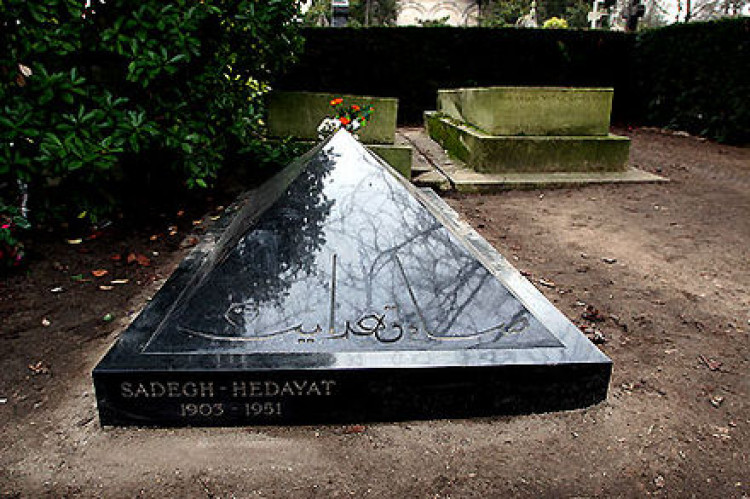
How Did Sadık Hidayet Die?
Hidayet committed suicide in Paris on 19 Farvardin 1330 at the age of 48 and was buried a few days later in plot 85 of the Père-Lachaise cemetery. The sheer volume of works and articles written about Sadiq Hidayet’s writings, life, and suicide are testament to his profound influence on the Iranian intellectual movement. Numerous Iranian orators of later generations, from Ghulamhossein Saedi, Houshang Golshiri, Bahram Beyzaei, Reza Ghasemi, Abbas Marouf, and others, were influenced to a greater or lesser extent by Hidayet’s work and life and spoke about him. The Sadiq Hidayet Literature Prize, organized by the Sadiq Hidayet Foundation, annually awards the Hidayet Statuette to the best work in Persian, from short stories to fiction.
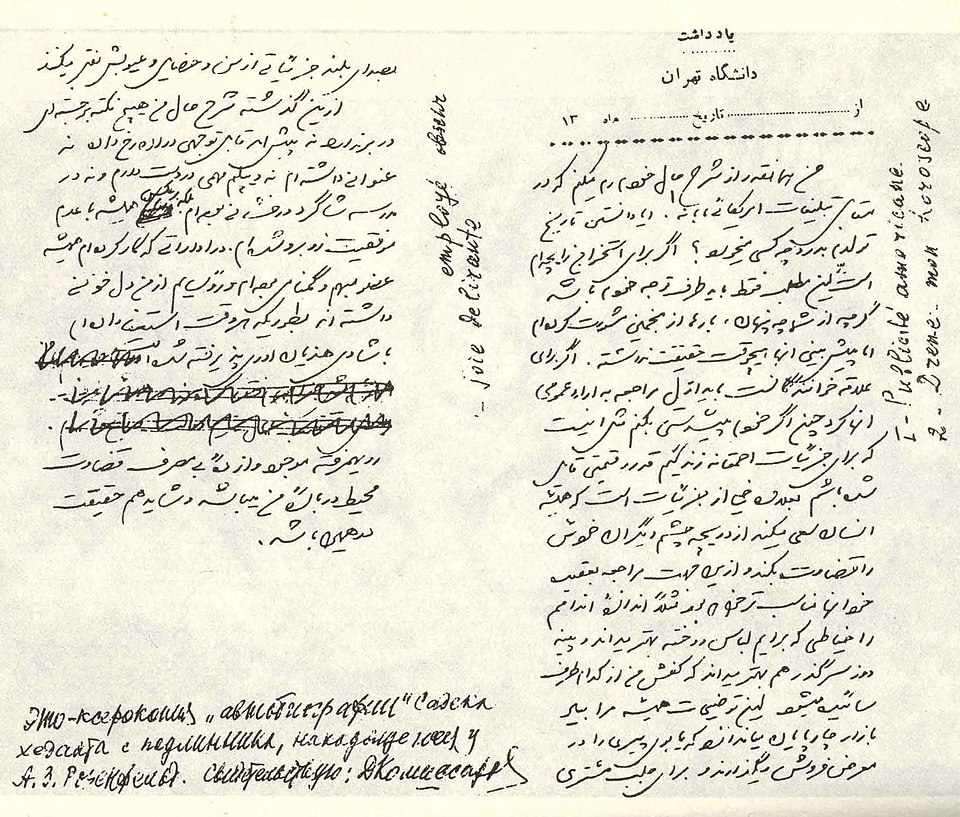
Sadegh Hedayat’s Own Biography
 Sadegh Hedayat: I’m as interested in my own biography as I am in American propaganda. Does knowing my birth date benefit anyone? If it’s for determining my horoscope, this should be for my own evaluation only. As you know, I’ve consulted astrologers numerous times, and their predictions have never come true. If it’s going to interest readers, I should first consult their general opinions, because if I were biased myself, I would be valuing the trivial details of my life. Furthermore, there are many details that one tries to judge oneself through the eyes of others, and therefore, it’s more appropriate to consult their own opinions. For example, the tailor who makes my clothes knows my body better than I do, and the shoemaker who passes by knows which side of my shoes is worn better than I do. These descriptions always remind me of the animal market where an old yabu is put up for sale, loudly announcing its age, features, and flaws to attract customers. Furthermore, my biography has no highlights. It contains no notable events, no titles, no important diplomas, and I wasn’t a brilliant student in school; on the contrary, I was always a failure. I’ve always been a faceless, anonymous member of the staff in the offices I’ve worked in, and my superiors were so fond of me that my resignation was met with enthusiastic joy. Ultimately, I’m a worthless product of my peers’ judgment of me, and perhaps that’s the truth.

Frequently Asked Questions About Sadegh Hedayat
Is Sadegh Hedayat Turkish?
Sadegh Hedayat was not Turkish; he came from a well-established and noble Iranian family. However, he was influenced by the cultural ties between Iran and Türkiye during the Ottoman period, and some of his works include references to Turkish culture.
Is Sadegh Hedayat an Atheist?
Hidayet’s works contain criticism of religion, but there is no definitive evidence to suggest that he was a complete atheist. Many researchers suggest that he held an agnostic or secular mindset.
At What Age Did Sadegh Hedayat Die?
Sadegh Hedayat committed suicide in Paris, ending his life at the age of 48 .
Faithful Guidance Religion
Although he was born into an officially Shiite Muslim family, he was critical of dogmatic religious views in his works.
Why Did Sadegh Hedayat Die?
Sadegh Hedayat, suffering from prolonged depression and despair about life, committed suicide by turning on the gas stove in the apartment he rented in Paris . His death left a deep impact on the literary world.
The Life of Sadegh Hedayat
Sadiq Hidayat was born in Tehran on Wednesday, 17 February 1903. His father was Hidayat Quli Khan (son of Etezad al-Mulk, Nayyar al-Mulk, Minister of Science during the reign of Nasir al-Din Shah) and his mother was Ziyor al-Muluk (Hidayet Quli Khan’s great-uncle, daughter of Husayn Quli Mukhbar al-Dawlah). Sadiq’s great-uncle, Reza Quli Khan Hidayat Taberstani, was a renowned Nasserist scholar and author of books such as Majma’ al-Fasha and Ajmal al-Tawarih. Sadiq was the youngest son in the family and had two older brothers, two older sisters, and one younger sister. His siblings included Mahmud Khan, a Supreme Court judge who served as deputy prime minister during the premiership of Lieutenant General Razm Ara. Isa Khan was a major general and former rector of the University of War. Both brothers were interested in art and literature. Lieutenant General Hacı Ali Razmara was the wife of Enver al-Muluk Hidayet, who was the brother-in-law of Sadegh Hedayat.
Sadegh Hedayat began his primary education at the Tehran Theological Seminary in 1908 at the age of six. In 1914, he published a wall newspaper called Nidai Amat at the school and began his secondary education at Darülfünun High School; however, he dropped out in 1915 due to an eye disease and studied at the Saint-Louis School, a French school, in 1916. According to Hidayet himself, his first encounter with world literature occurred at this school; there, he taught Persian to the school’s priest, who introduced him to world literature. It was at this school that Sadık became interested in the occult sciences and metaphysics. This interest continued, and Hidayet published articles on these subjects. That same year, Sadık published his first article in a weekly newspaper (edited by Nasrallah Falsafi) and received a three-month free subscription as a reward. He also collaborated with Tarqi magazine. During this period, Sadık was a vegetarian and ignored the urging and advice of his relatives to abandon vegetarianism. In 1924, while still in high school, he published a small book about compassion towards animals, Man and Animal, and in 1927 his book, The Benefits of Vegetarianism, was published in Berlin. A revision of Khayyam’s Rubaiyat, titled The Rubaiyat of Omar Khayyam (not to be confused with the book Songs of Khayyam), with a detailed introduction, was published by the Brokheim Library and Publishing House in Tehran in 1923. Sadeq published the short story “Biography of a Donkey in His Death” in the second year of issue 5-6 of Vafa magazine in 1924.
Was Sadegh Hedayat a Vegetarian?
Sadegh Hedayat became a vegetarian in his youth and wrote a book on the subject, The Benefits of Vegetarianism. He remained a vegetarian until the end of his life. Bozorg Alavi writes: “Once, I saw him at the Lalehzar coffeehouse, biting into a meatball called bolki in Russian. He thought there was something sweet inside, and suddenly his eyes turned red, sweat poured from his forehead, and on the verge of vomiting, he pulled a handkerchief from his pocket and spat out the unchewed morsel.”
He believed that if people wanted to stop war, they should first stop killing and eating animals.
In one passage of his book he writes: “There is no doubt that meat-eating leads to brutality. Everyone who desires moral progress and an improvement in the deplorable condition of society has tried to propagate this idea. If the tailors, butchers, fishmongers, and poultry shops were closed, some measure of social peace and human brotherhood would take on an outward form. Let us hope for the moral progress of man that bloody food should be abandoned and vegetarianism take its place. If true superiority comes from the heart, everyone should give up meat, which is neither difficult nor impossible. Many of those who make excuses out of ignorance, superstition, and fear exist only to avoid ridicule. The truth is that vegetarianism still remains an object of ridicule and scorn by those who do not know the truth; how many times have we laughed at the simplicity of our ancestors? The day will come when future generations will laugh at our superstitions.
Sadegh Hedayat’s European Movement
Hidayet graduated from Saint-Louis School in 1924 (at the age of 22), and it was during this year that he met Taghi Razavi. In 1926, he went to Belgium with the first group of students sent abroad and studied pure mathematics. That same year, he published his story “Death” in the 11th issue of Iranshahr magazine, published in Germany, and wrote an article in French titled “Witchcraft in Iran” in the 79th issue of Le Ville de Lis magazine. Hidayet was dissatisfied with the state of his education and field in Belgium and wanted to go to France and Paris, which were the center of Western civilization at the time. Finally, in March 1926, after changing his field and moving around a lot, he moved to Paris. That same year, he published a more comprehensive version of his book Man and Animal, and another book called The Benefits of Vegetarianism, with a foreword by Husayn Kazımzadeh, from Iranshahr magazine in Berlin, Germany.
Sadegh Hedayat’s First Suicide Attempt and First Stories
This photograph was taken in 1307 at Isa Hedayat’s home in Paris, after Sadegh Hedayat’s first failed suicide attempt in Paris.
In 1928, Sadegh Hedayat attempted suicide on the Marne River in France but was rescued by a boatman. At the same time, he was dating a girl named Therese in Paris. Sadık wrote to his brother Mahmud about his suicide: “I did something crazy, but it turned out well.” It was claimed that he never disclosed his first suicide to anyone. However, Farzaneh later reported (years after his first) that Hidayet had said that the reason for the suicide was emotional problems.
Hedayat’s first short stories appeared the same year as his failed suicide attempt. During this period, he wrote the plays Parvin, Sasan’s Daughter, Living in the Grave, and the short story “Madeleine.”
Sadegh Hedayat’s Return to Tehran
In 1920, Hidayet returned to Tehran without completing his education and began working at the Central Bank (in the accounting department and the shipping office). However, he was dissatisfied with his job situation and complained about his current situation in a letter to Taghi Razavi, whom he had befriended in high school in Paris. It was at the Central Bank that he befriended Hasan Gamiyan, whom he dedicated his time to promoting after Hidayet’s death. That same year, in Tehran, he published the book of stories Living in the Tomb and the play Parvin, Sasan’s Daughter. This year, Hidayet met Masoud Farzad, Bozorg Alavi, and Mojtaba Minoui, and a circle of friends called the Rabia Group was formed.
Rabeeh Group
At that time, a distinguished group of writers and literary figures called the Sab’ah writers existed, and according to Mojtaba Minoui, “Every magazine, book, and newspaper published in Persian was not devoid of their works.” Among these seven, there were actually more than seven, were individuals such as Mohammad Taqi Bahar, Abbas Iqbal Ashtiani, Rashid Yasemi, Saeed Nafisi, Badi’-o-Zaman Forouzanfar, and Mohammad Qazvini. The Rab’ah group chose this name to mock these individuals (whom they considered old-fashioned). The Rab’ah group’s conversations and meetings took place in restaurants and cafés in Tehran, among which was the Rose Navar Confectionery Cafe, where, around 1932, the faithful Hidayah and their friends hung out. Later, others such as Parviz Natel Khanlari, Abdolhossein Noushin, Gholamhossein Minbashian, and Nima Yushij joined the Rab’ah group. The group engaged in literary and cultural activities during these years and published numerous collaborative works. Minovi says of this period: “We fought fanaticism and sought freedom, and the center of our circle was Sadegh Hedayat.”
The years 1310–1314 are considered a productive period for Hidayet, and he published many works of research and fiction. These works include the Aniran collection of three stories, “Fath Eskander” by Sh. Parto, “Hucum Arab” by Bozorg Alavi, and “Hamle-e-Mughol” by Sadik Hidayet. This book is dedicated to Zabih Behrouz. Other works include the short story collection Saye-Roshan (containing 7 stories), the play Maziar with a foreword by Minovi, and the book Mustab-e-Ghogh Sahab, written in collaboration with Masoud Farzad. (This book was published in 1313, and in 1314, Hidayet was summoned to the Nazmiya of Tehran. This complaint was directly conveyed by the then Minister of Education, Ali Asghar Hekmat, and thus Sadik Hidayet became one of the first writers banned in the history of Iranian censorship.) The collection of stories called Three Drops of Blood and several other stories such as “The Whirlpool”, “Don Juan of Karaj”, “The Man Who Killed His Breath”, “Faces”, “Changal”, “Laleh”, “Afringan”, “Talb Amrzesh”, “Mahalle”, “Mordekhorha”, “Arosak Posht Parde”, the first edition of “Alawiyeh Khanum” and the travelogue “Isfahan Nefs Cihan” were published during this period.
Sadegh Hedayat’s Journey to India and the Publication of The Blind Owl and Return
Hidayat went to India with Shin Parto in 1936 and stayed in his apartment. In India, he learned the Pahlavi language from Persian scholar (of Indo Persian) Bahram Gur-Ankalsaria and translated the works of Ardashir Babakan from Pahlavi to Persian in India.
During his stay in Bombay, he published fifty copies of his famous work, The Blind Owl, which he had hand-written on stenciled paper while in Paris, using a polygraph machine, and sent these to friends; he sent one copy to Mujtaba Minovi, who was living in London, and another to Jamalzadeh, who was in Geneva at the time. Some believe that the story of The Blind Owl stemmed from the Indian atmosphere, but conversations between Hedayat and Farzaneh suggest that Hedayat had begun working on the work years earlier, and according to Hedayat, the work had become stuck in his throat. citation needed: In the polygraph version of The Blind Owl he published in India, he wrote that its publication in Iran was prohibited. Hedayat also published two other stories in French in India (“Lunatique” and “Sampingue”).
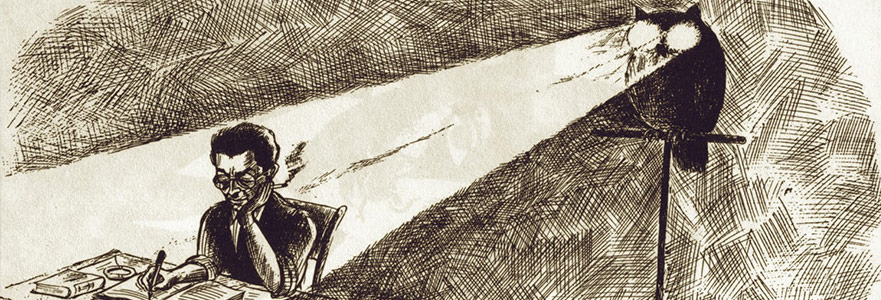
After his trip to India, Hedayat faced severe financial hardship and was supported by Sh. Parto. This poverty and defeat, brought on by societal neglect, led Hedayat to turn to satire, and this bitter satire further exposed the wounds in his heart.
Hidayet returned to Tehran from India in 1937 and continued his work at the National Bank. The following year, he resigned from the National Bank and began working at the Ministry of Culture. He continued his literary activities until the Allied occupation of Iran in 1941, publishing numerous stories and articles. He published Ardashir Babakan’s career in the Music Journal and Gojesteh Abalish (a translation of the Pahlavi text) separately (by Ibn Sina Publications). Despite this, Kör Owl remains unpublished in Iran.
The Allied Occupation of Iran and the Opening of Political Space
In 1942, he published the collection “Stray Dog” and translated Iranian Cities, The Report of Doubt, and Jamasp’s memoirs from Pahlavi into Persian. Between 1945 and 1947, and at the end of World War II, Sadegh Hedayat’s social criticism intensified. The long story “Hacı Ağa”, the short story “The Water of Life”, and the collection “Valangari”, all of which contained social themes, were published during this period. In addition to these activities, Hidayet also wrote literary criticism articles and translated Kafka’s works, which were published in various publications. He also translated many other works by Pahlavi. In 1945, he went to Tashkent and was honored by the Iranian-Soviet Cultural Association.
During this period, many of Hidayat’s friends, including Alavi and Abdul Hussein Nushin, joined the Tudeh Party, and his contacts with the Tudeh Party in general increased, even publishing articles under a pseudonym in the Tudeh Party’s newspaper, Mardom. However, despite the insistence of party leaders, he never joined the Tudeh Party.
 The End of War, Hopelessness, and Despair
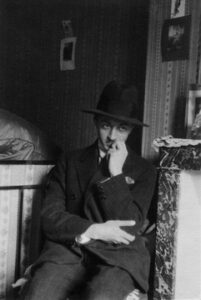
After the war ended and the emergence of the Kurdistan and Azerbaijan issues, Hidayat became increasingly disillusioned with the masses and pessimistic about the situation. This pessimism is evident in his letters to Jamalzadeh and Shahid Nouraei. According to Payam Yazdanjo, during these years, Hidayat had lost hope for Iran’s rebirth through his opposition to superstition, authoritarianism, and enlightenment, and his desire for Iranian greatness.
In 1947, he began writing Top Marvari, but this work was published posthumously. His most famous pseudonym, under which Top Marvari was also published, is Hadi Sedaghat. In 1948, he wrote the essay “Kafka’s Message” as an introduction to Kafka’s The Prisoner, and it was translated by Hasan Ghaemian. In 1949, with the help of Hasan Ghaemian, he translated Kafka’s story “The Metamorphosis” and published it in Sokhan magazine. On 12 December of that year, after obtaining a medical report to obtain a visa and selling his books, he left for France. During his stay in France, he went to Hamburg and also tried to go to London, but was unsuccessful. Finally, on Monday, 19 April 1955, he committed suicide by gas in his rented apartment on Champenoise Street in Paris. He is considered the first Iranian writer and author to commit suicide. A few days before his suicide, he had destroyed most of his unpublished stories. Hedayat was buried in Père Lachaise Cemetery in Paris. A small number of Iranians and French people attended his funeral.
Sadegh Hedayat’s house
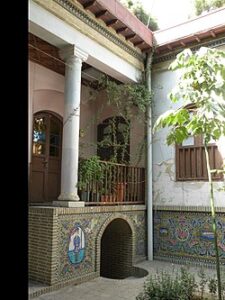
The house of Sadiq Hidayat is located in Tehran, on Sadi Street, above Manouchehri Street, on the southwest side of Amir A’lam Hospital, at Shahid Taghavi Street (Hedayat Street), No. 3, next to the house of the Danish Ambassador. The house in question was built by Sadiq Hidayat’s father, and its form and structure date back to the late Qajar period. In the 1970s, Farah Pahlavi’s office purchased the house of Sadiq Hidayat’s father and, collecting personal belongings from survivors, converted it into a museum dedicated to Sadiq Hidayat. This was not done after the 1979 Iranian Revolution. The new government confiscated the property and gave it to Tehran University of Medical Sciences. It was later used as a kindergarten for the staff of the “Sadeghiyeh Kindergarten”.
The building was finally inscribed on Iran’s National Register of Monuments on November 16, 1999, under the number 2491. In 2002, Hedayat’s nephew, Jahangir Hedayat, and others protested against the house’s use by the University of Medical Sciences, which converted it from a kindergarten into a library. These protests continued until the house was eventually converted into a museum. In 2013, the garden and grounds of Sadegh Hedayat’s house were converted into a hospital waste storage facility.